
Raw Reclaimed Ulin or Calibrated Components?
Reclaimed timber does not always need to look uniform, but structural components often benefit from controlled dimensions before they reach the construction site.
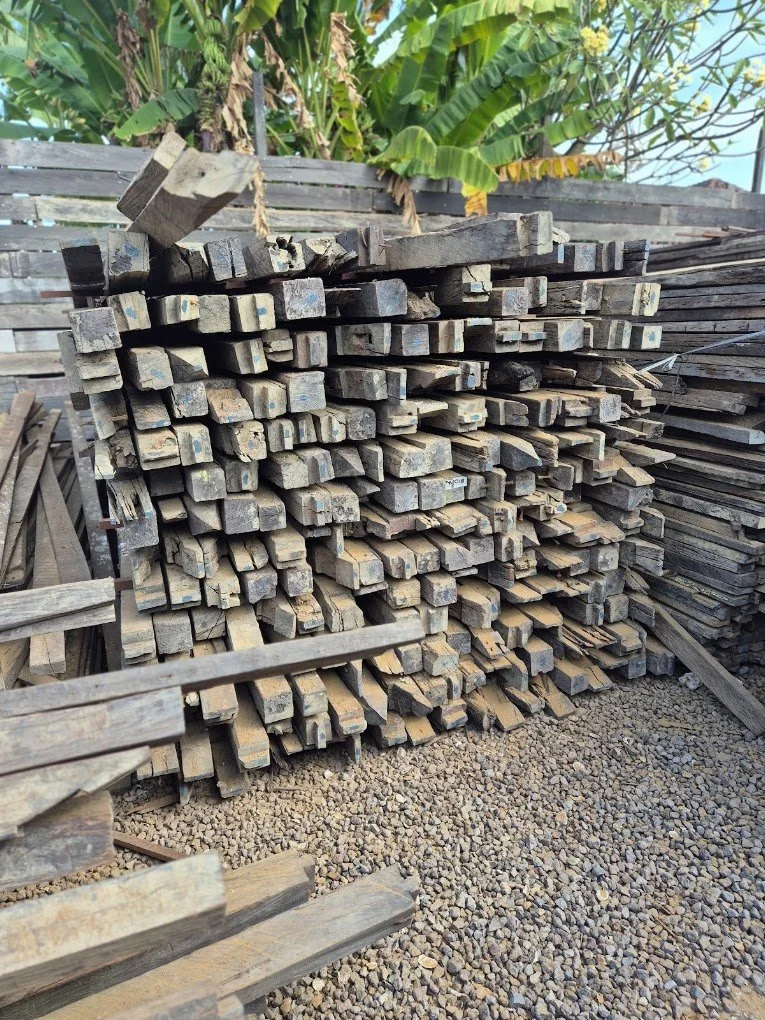
Reclaimed Ulin can be used in two very different ways.
In one project, an architect may deliberately want large beams or posts to retain their original reclaimed character: old surfaces, weathering, colour variation and evidence of their previous life.
In another project, the contractor may need dozens of joists, battens or rafters to arrive with controlled dimensions so they can be installed efficiently and consistently.
Both approaches are valid. The important point is to specify which one the project actually requires before production begins.
Raw reclaimed timber and finished components are not the same product
At Naturanexa, raw reclaimed Ulin refers to timber recovered from previous Indonesian structures and infrastructure before it has been fully processed into a finished architectural component.
Raw pieces naturally vary. Individual sections may show differences in colour, grain, surface condition, previous fixing holes or other marks associated with reclaimed timber.
For some applications, that variation is exactly what gives the material its architectural value.
Large beams, posts, pergola elements and exposed architectural timber can retain some of that original character while still being selected and prepared for a new project.
You can see the current range of raw and structural reclaimed Ulin on the Naturanexa lumber page .
When dimensional consistency becomes more important
Battens, joists and rafters usually perform a different role from a one-off character beam.
When a project requires repeated sections, consistency can make installation substantially easier.
If twenty or fifty pieces are intended to form part of the same roof structure, subframe, screen or architectural rhythm, large dimensional differences between individual pieces create additional work on site.
This is where machining reclaimed timber into calibrated components becomes valuable.

Naturanexa processes reclaimed Ulin into repeatable battens, joists and rafters according to project requirements.
The purpose is not to make reclaimed timber look artificial. It is to control the dimensions that matter while preserving the material itself.
A reclaimed surface can still be part of a precise building system
Reclaimed timber and precision are sometimes incorrectly treated as opposites.
They are not.
A beam can retain visible reclaimed character while selected faces, connection points or dimensions are machined accurately. Likewise, a joist can originate from reclaimed timber but be processed to a consistent finished section.
The correct level of processing depends on how the component will be seen and how it will be installed.
Start by defining what is structurally important
Before ordering reclaimed structural timber, the project team should identify which dimensions are critical.
For a concealed substructure, repeatable thickness and width may matter much more than surface appearance.
For an exposed roof structure, dimensions remain important, but colour, texture, grain and reclaimed character may also form part of the design.
For a large post or beam, the architect may deliberately accept more visible variation while requiring accurate joinery at connection points.
The specification should reflect these priorities instead of simply stating a species and nominal size.
Nominal dimensions and finished dimensions should not be confused
One of the simplest ways to avoid misunderstandings is to state clearly whether a requested dimension refers to the timber before processing or to the final finished component.
Machining removes material. Straightening, trimming or surfacing can therefore reduce the final section.
When exact finished dimensions matter, they should be defined as such when the quotation is prepared.
This becomes particularly important for repeated components that must align with steel, masonry, roofing systems, glazing or other prefabricated elements.
Reclaimed material should be selected before machining
Processing reclaimed Ulin is not simply a matter of feeding every recovered piece through the same machine.
Individual sections must first be assessed for their intended use.
The required finished dimensions, appearance, length and application influence which pieces are appropriate for further processing.
This selection stage is particularly important when the project requires a sequence of similar visible components.
Moisture and dimensional movement still matter
Ulin is known for its durability, but reclaimed timber remains wood and therefore continues to respond to environmental conditions.
The USDA Wood Handbook explains that wood properties and dimensional behaviour are influenced by moisture conditions and grain direction.
Architects and contractors should therefore consider the operating environment, connection design and intended exposure when specifying structural timber.
What should an architect or contractor send to the supplier?
A useful reclaimed Ulin enquiry should include more than a product name.
- Required component type: beam, post, joist, rafter, batten or other element.
- Required finished dimensions.
- Required lengths and quantities.
- Whether the component will be visible or concealed.
- Preferred surface character: raw, rustic, processed or smoother finish.
- Any drawings showing connections or joinery.
- Whether dimensions must repeat consistently across a series.
- Expected interior, exterior or exposed application.
- Project location and installation conditions.
These details allow the material to be selected and processed for its real function instead of forcing the installer to resolve avoidable dimensional issues later.
The right specification depends on the component
There is no advantage in machining every reclaimed beam until all traces of its previous life disappear.
Equally, there is little benefit in preserving unnecessary dimensional variation in a repeated structural component if that variation complicates installation.
The better approach is selective.
Preserve reclaimed character where it contributes to the architecture. Control dimensions where construction requires consistency.
Naturanexa applies this principle across reclaimed Ulin battens, joists and rafters , structural timber and custom architectural components manufactured in Bali.
The result is not reclaimed timber forced into perfect uniformity. It is reclaimed timber prepared for a specific architectural purpose.